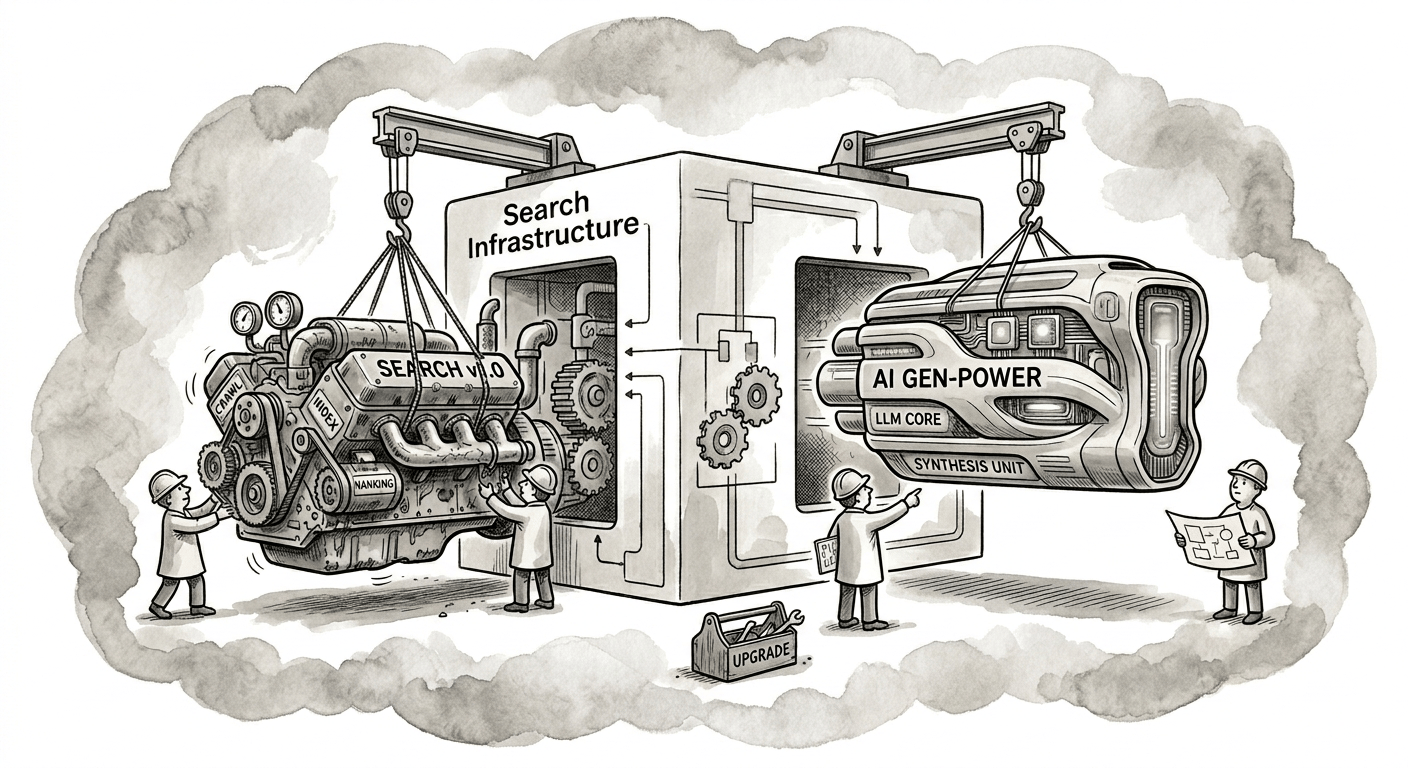
Google used this week's I/O to make Gemini 3.5 Flash the default model in AI Mode, globally. The surface that started booking UK restaurants on 10 April is, six weeks later, running on a different brain.
The default moved without a press release
The change sits inside a wider I/O post, sandwiched between an agent SDK and a redesigned search box. The relevant line is one sentence: "we're upgrading Search with Gemini 3.5 Flash — our newest Flash model delivering sustained frontier performance for agents and coding — as the new default model in AI Mode for everyone globally."
That is the entire change notice. No staged rollout was named.
For a restaurant whose AI Mode footprint depended on the old default making certain trade-offs — what dietary tag it weights, how it scores neighbourhood proximity against a 4.3-star cutoff — those weights have moved, silently, between one session and the next.
What changes downstream
Gemini 3.5 Flash is faster and cheaper for Google to run. That matters less than the second-order effect. Flash models have historically given Google more room to fan out across sources per query, and more reason to pull structured fields directly out of pages rather than reasoning over prose. Whether AI Mode is doing either of those things more aggressively today than it was on Monday is testable; Google has not said.
The model upgrade is the part of the announcement that lands today. The shape of the change is what restaurants will find out about by watching their own bookings.
Agentic booking is expanding past restaurants
The other half of the I/O announcement is the more telling one. Agentic booking, the feature that lets a diner ask AI Mode for a table in Manchester and complete the reservation inside Google, is being extended beyond restaurants. The example in the I/O post is a private karaoke room that serves food late. Other local services follow. Free users in the US get the broader version this summer.
Google ran the same play with restaurants on 10 April in the UK — sign the booking platforms, then complete the transaction inside Google. Restaurants were the first vertical to land on this agentic shelf. The others are queuing.
Operators in other verticals can read the next year of their own platform fights in last year's restaurant ones.
What restaurants should do this week
Nothing new, which is the plain honest answer. The data shape that earned an Italian place in Manchester a recommendation last Friday is the same data shape Gemini 3.5 Flash is reading on Wednesday: a Schema.org-marked menu, opening hours that match Google Business Profile, dietary tags the kitchen can stand behind, prices that have not drifted from the printed card.
What is worth doing is watching. Open AI Mode tonight and ask the same restaurant-discovery query you asked a fortnight ago. If the answer has shifted — a different shortlist, or a venue you have never seen surface before — the new model is making different calls on the same underlying data. That is a signal for tuning your schema, not for panic.
Menu software that outputs Schema.org as a side-effect of menu updates keeps the data layer steady when the model layer moves. The model can change every six months. The MenuItem entries do not.
The pattern survives the model
A model swap inside a product layer is not a feature launch. It is a quiet upgrade whose consequences a restaurant only sees through its own data — which shortlists it lands on and which queries it stops being legible to.
The agentic-booking expansion is louder and slower. By autumn, AI Mode in the US will be quoting prices on plumbers and karaoke rooms the way it already quotes a 7:15 slot at an Italian place. The restaurant cohort got there first and earned the bugs.
Gemini 3.5 Flash drove the search this morning. By August the engine will have moved again.