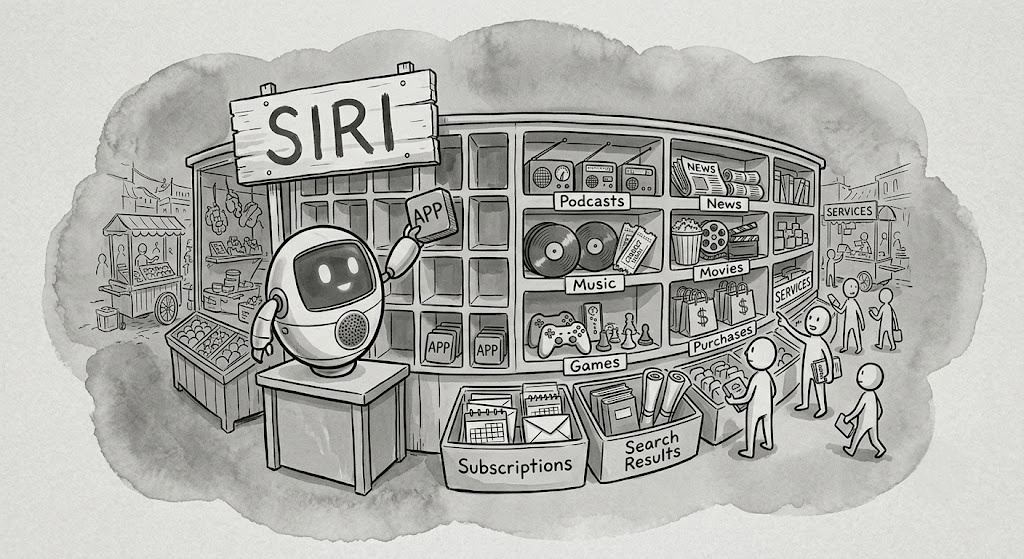
Apple's WWDC keynote on 8 June rebuilt Siri on a custom Gemini model and opened it to rivals in the same breath. Through iOS 27 Extensions, a user can switch the default to Claude, ChatGPT or Grok; the choice lives in Settings. Siri's brain is now a marketplace.
The default has changed
Apple confirmed on 8 June that the rebuilt assistant, branded "Siri AI", runs on a custom Gemini model under a multi-year licensing agreement signed in January. The figure that keeps surfacing across coverage is roughly $1 billion per year. Under the hood Apple is using a three-tier routing system: simple commands stay on the device's Neural Engine, moderate queries hit Apple's Private Cloud Compute, and the heaviest reasoning runs on Google Cloud's Nvidia Blackwell GPUs.
That last tier is where restaurant discovery lives. "Find me somewhere doing a vegan pudding open after 9pm" isn't a timer; it's a reasoning query. By the autumn, when iOS 27 ships in gated beta, that question will be Gemini's to answer on every iPhone the user hasn't reconfigured.
iOS 27 Extensions makes Siri swappable
The genuinely new thing is iOS 27 Extensions: a framework that opens Siri, Writing Tools and Image Playground to third-party AI providers through a dedicated App Store marketplace. The supported set named on day one is Claude, ChatGPT, Google Gemini and Grok. In Settings, users can pick which one handles Apple Intelligence system features — including the voice questions Siri can't, or won't, handle itself.
What used to be one assistant is now four, all reading the same restaurant from different angles.
That changes the calculus for a restaurant trying to be found by voice. There is no longer a single assistant whose preferences you can chase. You need menu data that every one of those models can lift, because you don't know which one is set as the user's default.
The common language is still structured data
Each of the four — Gemini, Claude, ChatGPT and Grok — already reads structured data when it's there. That isn't an Apple decision; it's how each model consumes the web. They diverge on style, tone and refusal behaviour, but on machine-readable input they converge.
A restaurant page that exposes Schema.org's Restaurant, Menu and MenuItem types — with prices, dietary flags, allergens, opening hours — feeds all four equally. A page that hides the menu inside a PDF, or worse, only on a Facebook post, feeds none of them.
Siri's camera reads food labels now
A quieter announcement, easy to miss in the keynote: the new Siri can pull nutritional data from food labels using the Camera app. That capability isn't, on its own, a restaurant story. But it tells you where Apple thinks this is heading. Diners pointing their phones at packaging today will point them at menus tomorrow. The model that wins is the one that can match what it sees against a structured source.
If your menu lives only in printed form on the table, you're trusting the OCR. If it lives also as JSON-LD on your website, the camera has somewhere to verify against.
The rollout is gated, not instant
Public release of iOS 27 is scheduled for September. Siri AI ships then as a "gated beta", with features arriving in stages rather than all at once. Apple hasn't published the per-feature timeline, and the third-party marketplace will open alongside iOS 27 rather than before.
That gives a UK restaurant a summer to get its menu in shape.
What to fix before the autumn
Three checks are worth running this week, on your existing website, in this order. Does each menu item live in HTML rather than a PDF? Does each item carry a price, a section, and any relevant allergen or dietary tag in Restaurant/Menu/MenuItem schema? Do your address, opening hours and cuisine type appear in LocalBusiness schema on every page that needs them?
Menu software that handles the markup as a by-product of editing — that is GMMO's whole job — gets you there without writing JSON-LD by hand. The work is in keeping the menu current. The structured copy is downstream of that.
When the autumn beta lands, four assistants will be reading you. The ones that can't make sense of what they see will move on to a restaurant whose page tells them what it serves.