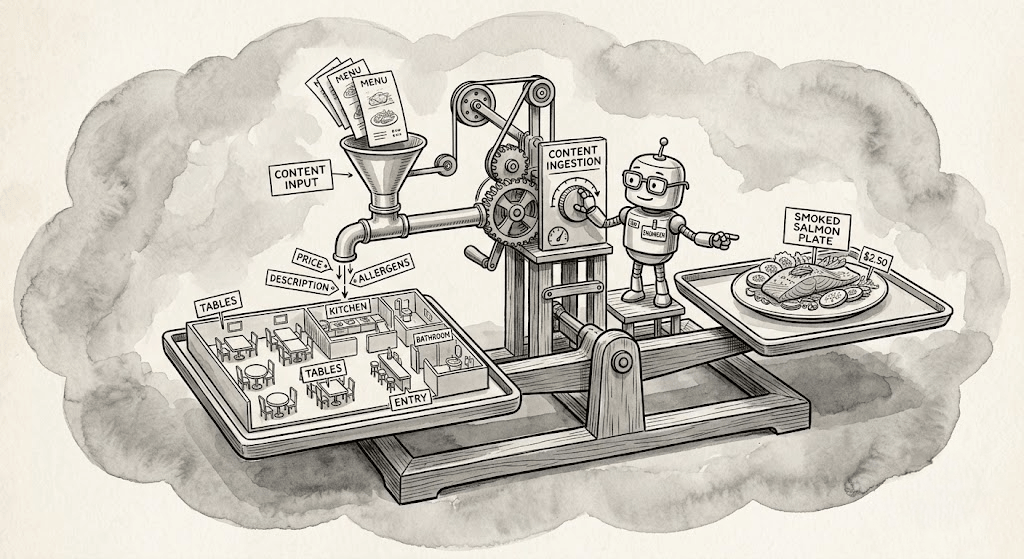
The first public dataset of structured-data usage across the web, released by Schema.org and Google on 4 June, puts restaurant menu markup in a measurable position for the first time. Menu and Restaurant each sit in the 100,000-to-1-million-domains bucket. LocalBusiness — the type most web agencies prioritised first — sits a full bucket above that, in the 1-to-10-million range. The front door landed at scale. The menu did not.
Schema.org started counting in public
The dataset, published by Google's web indexing team and hosted on the Schema.org GitHub repository in CSV and JSON, covers 958 schema Types and 4,587 Properties. Counts are bucketed at the domain level — "1 million to 10 million", "100,000 to 1 million", and so on — refreshed monthly. PPC Land covered the release on 6 June. The numbers now sit on each schema page directly; a glance at schema.org/Menu shows the bucket alongside the type.
The point of bucketing rather than exact counts, the announcement noted, is to "filter daily noise while highlighting meaningful adoption trends". You cannot game it by adding a single domain.
Ryan Levering, the Google engineer who shipped the release, framed it as overdue. Dan Brickley, one of Schema.org's founders, had been asking for these numbers for years.
What the restaurant numbers actually say
Recipe, the cousin food publishers and home cooks deploy, sits one bucket below Menu at 10,000 to 100,000. FAQPage, despite Google ending the rich result on 7 May, still lands in the 1-to-10-million range.
The gap between LocalBusiness and Menu is roughly an order of magnitude. A restaurant site can register in the LocalBusiness bucket and not appear in the Menu one at all. The data suggests that is what tends to happen.
The front-door schema landed at scale years ago. The actual menu — the part that lets an assistant pick a dish for a diner with a gluten allergy — has not.
A benchmark you can plan against
A range of 100,000 to 1 million is wide, and that is the point. It distinguishes a type on hundreds of thousands of sites from one on tens of thousands, without pretending the underlying crawl is exact. For an operator deciding whether menu markup is worth the effort, the framing is sharper now: aligned with Recipe, smaller and niche, or with LocalBusiness, where the rest of the web already is.
The dataset will be refreshed each month, and other crawlers are invited to publish their own statistics in the same format. Bing has not yet committed. Common Crawl could.
What changes for restaurant sites this week
Three practical effects land immediately.
A web agency can now justify menu-schema work to a client with a public number rather than a hand-wave. "Your competitors are in this bucket; you should be in the next one up" is a sentence that closes a budget conversation in a way "trust me" never has.
A restaurant SEO can compare the site's deployed types to the public bucket and find gaps in minutes. A site shipping LocalBusiness and skipping Menu now sits in a measurable position, not a guess.
Menu software vendors — GMMO among them — can point to a public, third-party benchmark of which schemas the market deploys. Adoption claims become checkable.
The rich result was a render. The data is a market.
Last month's FAQ deprecation showed how quickly a rich result can disappear. The Schema.org usage dataset is the other side of the same point. The rendering on a SERP is the part Google controls and changes. The structured data underneath is the part you control, the part that travels across the assistants and crawlers reading the page.
For the first time, the size of that underlying market is a public number. Bucketed, monthly, on GitHub.