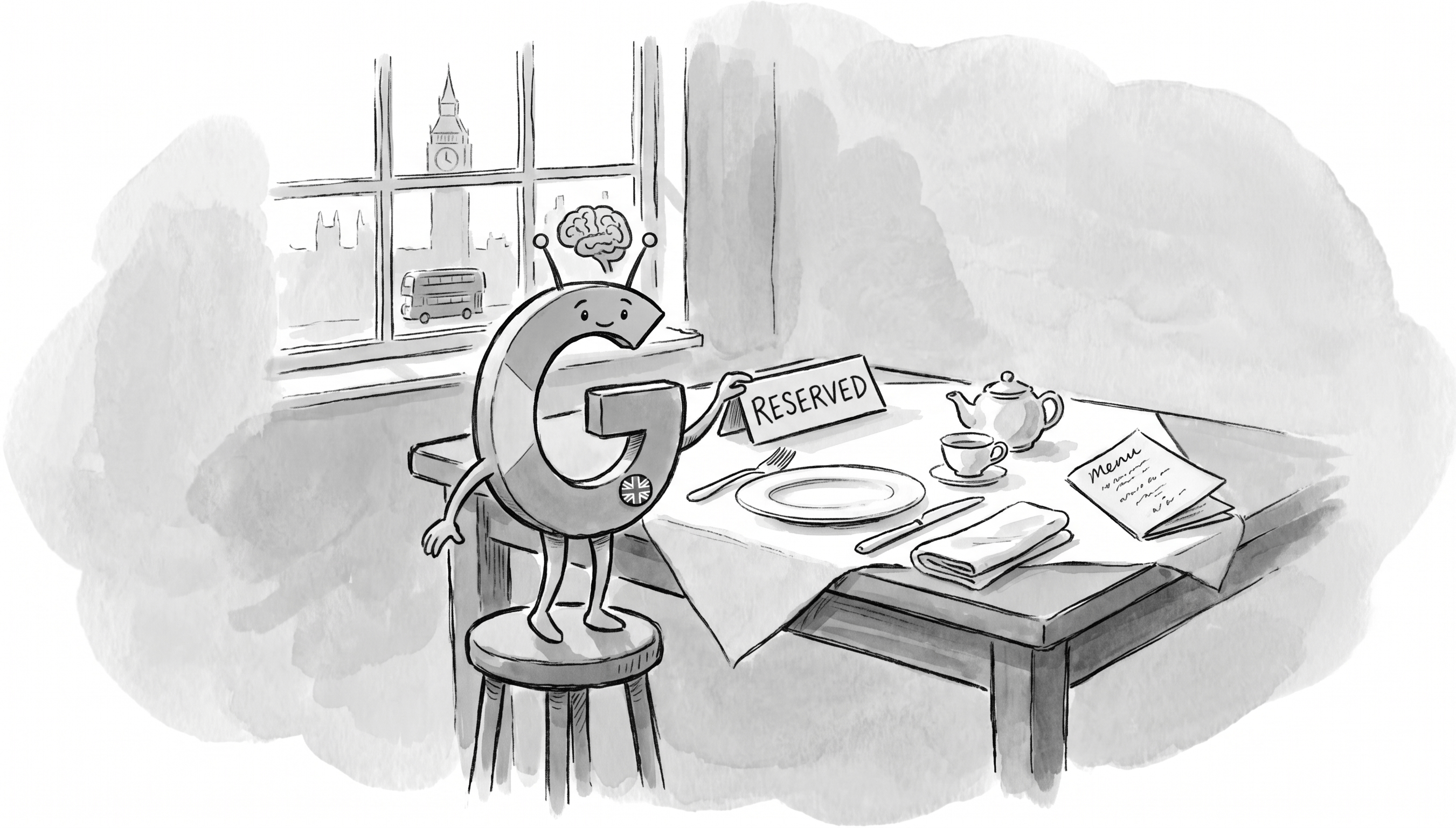
On 10 April 2026 Google switched on agentic restaurant booking in AI Mode for UK users. A diner describes the table they want — cuisine, location, party size, time — and Google completes the reservation through one of eight booking platforms. The restaurant's website never loads. The traffic never arrives.
A booking completed without your website
Google's agentic restaurant booking in AI Mode connects to eight UK reservation platforms: TheFork, OpenTable, SevenRooms, ResDiary, Mozrest, Foodhub, Dojo, and DesignMyNight. A user describes what they want in natural language — occasion, cuisine, location, time — and receives a curated list with direct reservation links, without leaving Google's interface.
The booking happens inside the AI layer. No organic search visit. The conversion is recorded by the platform, not by whoever built the restaurant's site.
Which restaurants appear in the answer
The eight platforms are the gatekeepers. A restaurant listed on TheFork or OpenTable can be surfaced by AI Mode and booked through it. One that only takes reservations by phone, or through a contact form on its own site, is invisible to this feature — not ranked lower, simply absent from the interaction.
This is a sharper version of a pattern that has been developing for years. Google's local features have always favoured businesses with complete, accurate, machine-readable data. Agentic booking extends that logic to transactions: the restaurants in the answer are the ones whose availability is queryable by a machine, in real time, through one of Google's chosen platforms.
What disappears when the diner books through AI Mode
When a reservation arrives via AI Mode, it comes through the platform. The restaurant sees an entry in its diary. It does not see which query prompted it, which venues the diner compared, or whether they almost booked somewhere else.
The first-party relationship with the customer is gone before it starts.
The restaurants in Google's AI Mode answer are the ones whose availability is queryable by a machine, in real time, through a platform Google has chosen to integrate.
For restaurants that have invested in their own websites — proper schema markup, direct booking widgets, loyalty sign-ups on confirmation pages — none of that infrastructure is touched when a booking comes in through AI Mode.
The case for getting the data right now
Google's agentic booking is currently UK-only, paired with a redesigned mobile interface and Gemini 3 as the underlying model. It will expand. The pattern — describe what you want, let the AI resolve it — is how Google is moving across multiple verticals.
The restaurants that will hold their footing in this shift are the ones with data that a machine can trust: a menu accurately marked up with dietary information and pricing, an address that matches across Google Business Profile and the restaurant's own site, opening hours that are current. These details determine whether AI Mode recommends a restaurant confidently or skips it.
The schema on a restaurant's own website — GMMO produces this automatically — is where booking platforms and Google alike pull the facts they need to describe what the kitchen serves. A restaurant that keeps that source of truth accurate is the one that travels well into whatever interface comes next.
The booking surface changes. The data underneath stays the same.